Americans increasingly reject Iran war as polls show growing support for diplomacy
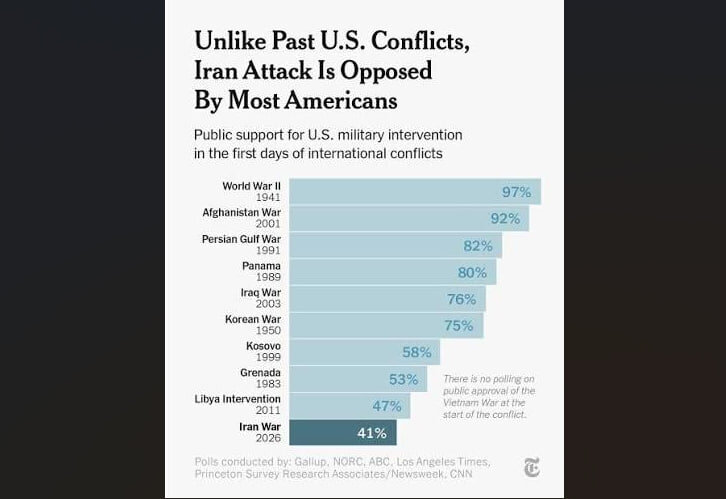
TEHRAN- A majority of Americans want the United States to end its war with Iran, refrain from further military action, and pursue diplomacy instead, according to a new national public opinion survey by a leading US polling organization.
The survey found that 52% of Americans believe Washington should end the war, take no further military action against Iran, and pursue a diplomatic solution. Half of respondents said the conflict should end immediately, even if the US government has not achieved all of its stated objectives.
The findings reflect growing skepticism among Americans about the continuation of the conflict and its consequences for US interests. Fifty-eight percent said the war has had an overall negative impact on US interests, while only 15% believed the United States had won or was winning the war.
The survey also found that 54% of Americans believe that, because the war was illegal, the United States should compensate Iran for damages caused by the conflict.
The results are consistent with findings from several other major US polling organizations.
A University of Maryland Critical Issues Poll conducted by Ipsos found that most Americans wanted the war to end immediately and favored pursuing any remaining US objectives through non-military means. Only 15% said the United States had won or was winning the war, while 60% said the conflict had been more negative than positive for US interests.
An Economist/YouGov poll conducted in June found that 66% of Americans believed the United States should reach a deal to end the war as quickly as possible. Only 25% said the United States had won, while 41% said neither side had won.
An Ipsos Iran War Tracking Poll conducted in March similarly found that 66% of Americans wanted the United States to end its involvement in the conflict quickly, even if doing so meant that Washington would not achieve all of its stated objectives. Only 27% favored continuing the conflict until all US goals had been met.
Ipsos polling in April found that 51% of Americans believed US military action in Iran had not been worth it, compared with 24% who considered it worthwhile. The survey also found widespread concern about the conflict's economic consequences.
A separate Quinnipiac University national poll released in July found that 60% of registered voters opposed US military action against Iran, compared with 34% who supported it. Quinnipiac said this represented the highest level of opposition it had recorded since it began tracking the issue in March.
The Chicago Council on Global Affairs-Ipsos survey conducted in May also found that Americans viewed the war as damaging to several key US interests. Majorities said the conflict had been harmful to the cost of living, US international relations, America's reputation abroad, and national security. The survey also found that 63% believed the Trump administration had not done enough to pursue a negotiated settlement.
Taken together, the polling points to a broadening public preference for ending the conflict and pursuing diplomacy rather than expanding US military involvement. Although Republicans have generally been more supportive of President Donald Trump's approach than Democrats and independents, opposition to continued military action has appeared across the political spectrum.
The public mood also comes as Americans face the broader economic and political consequences of the conflict, including concerns over energy prices, household finances, and the direction of US foreign policy.
The convergence of polling results suggests that a substantial portion of the American electorate is increasingly questioning whether continued military action serves US interests and is instead favoring an end to the war and a negotiated settlement.
Leave a Comment